How much to charge for machine embroidery: a formula, real price tables and a free calculator
How to price machine embroidery: a cost formula, real US shop price tables and a worked example with Satinwise's free embroidery price calculator.
Satinwise Team6 min read
Undercharging is the most expensive mistake an embroidery shop can make: every piece goes out the door, yet the month doesn't add up. Overcharging doesn't help either if the customer walks. The good news is that an embroidery price isn't a mystery: it comes from your costs, your machine time and the margin you want.
This guide gives you the formula, what real shops that publish their price tables charge, and a full example you can repeat with your own numbers in the embroidery price calculator.
What sets the price of embroidery
Wilcom, the maker of the EmbroideryStudio software, lists the factors that drive pricing in its help center (Wilcom, "Embroidery pricing", Spanish edition):
- Setup: every job, however small, involves setting up the machine and handling the order. It's usually a fixed cost.
- Digitizing: turning the logo into a stitch file.
- Quantity: fixed costs are spread across more pieces, so the per-piece price drops.
- Stitch count: machines have a top speed, so more stitches mean more minutes.
- Item type and placement: caps, jackets or hard-to-hoop spots take longer.
- Fabric: some fabrics force a slower speed.
- Colors: each thread change takes time and is one more chance of a thread break.
- Special processes: sequins, appliqué and the like.
One point on that page is worth remembering: on small orders the exact stitch count matters less, because setup and handling are the biggest cost. On large orders, stitch count matters a lot.
The formula: costs + machine time + margin
For your own shop, the clearest way to a per-piece price is to add up your costs and apply your margin. It's the same formula the Satinwise calculator uses:
| Item | How it's calculated |
|---|---|
| Garment | What the garment costs you (0 if the customer supplies it) |
| Thread | (stitches ÷ 1,000) × your thread cost per 1,000 stitches |
| Stabilizer | Your cost per piece |
| Machine time | (minutes per piece ÷ 60) × what an hour of machine time costs you |
| Labor | Your cost per piece (hooping, trimming, folding) |
| Cost per piece | The sum of the above |
| Price per piece | Cost × (1 + margin %) |
Minutes per piece come from the stitch count and your machine's speed, plus the time for thread changes. On a single-needle machine you change thread by hand; on a multi-needle machine it changes on its own and the time drops a lot.
What the file doesn't show
Besides stitches, some costs are worth charging separately or building into your rate:
- Digitizing, once per design.
- Setup on small orders (a flat fee or an order minimum).
- Hard-to-hoop items: caps, bags, leather, heavy jackets.
- Customer-supplied garments: the risk of ruining one is yours.
What real shops charge (public price tables)
These are tables three US shops publish on their websites (checked October 19, 2026). They're not "the market price": they're real examples of how a price is structured. Each shop has its own terms, so read the source before comparing yourself.
| Shop (source) | How it prices | Published example |
|---|---|---|
| Threads Embroidery & More (Austin, TX) | Table by stitches and quantity, embroidery only (customer supplies items) | Up to 6,000 stitches: 12.50 USD (1-9 pieces), 10.00 USD (10-24), 8.00 USD (25-49). Each additional 1,000 stitches: 1.25 / 1.00 / 0.80 USD. Flat 15 USD setup on 1-24 item orders. |
| Graphic Apparel (College Place, WA) | Table by stitches and quantity, on items they sell | Under 9,000 stitches, 24-47 pieces: 5.13 USD per embroidery. Customer-supplied items: +5.00 USD. Digitizing: 50 USD per hour (1-hour minimum). |
| Neatko (Leander, TX) | Per-piece price range | One placement, up to about 8,000 stitches: 15 to 25 USD per piece. New logo digitizing: 30 to 50 USD (included on 24+ pieces). Your own garments: +5 USD. |
What they have in common:
- Price drops with quantity. Every table has quantity breaks.
- Extra stitches are charged on top. Past a cap, every 1,000 stitches adds up.
- Digitizing is a separate fee, sometimes waived on large orders.
- Customer-supplied garments cost more, because of the risk.
A worked example with the calculator
Let's quote 24 polo shirts with an 8,000-stitch, 4-color logo. The costs below are the Satinwise calculator's starting values, not market prices: replace them with yours.
| Input | Example value |
|---|---|
| Garment | 5.00 USD |
| Thread | 0.05 USD per 1,000 stitches |
| Stabilizer | 0.25 USD per piece |
| Machine hour | 8.00 USD |
| Labor | 2.00 USD per piece |
| Margin | 60 % |
On a single-needle machine (the calculator assumes 600 stitches per minute and one minute per manual thread change):
- Time: 8,000 ÷ 600 = 13.3 min + 3 thread changes = 16.3 min per piece.
- Cost: 5.00 (garment) + 0.40 (thread) + 0.25 (stabilizer) + 2.18 (machine) + 2.00 (labor) = 9.83 USD.
- Price: 9.83 × 1.60 = 15.72 → rounded up to the dollar: 16 USD per piece, 384 USD for the order, about 148 USD profit.
On a 12-needle machine (1,000 stitches per minute; color changes are automatic):
- Time: 8,000 ÷ 1,000 = 8 min + 0.3 min of changes = 8.3 min per piece.
- Cost: 8.76 USD → price 15 USD per piece, 360 USD for the order.
Almost all the difference between the two machines is time. That's why, with few needles, designs with many colors should cost more.
Try your own numbers in the embroidery price calculator: change stitches, colors, pieces and costs and instantly see the price per piece, the order total and your profit.
5 common quoting mistakes
- Charging only by stitches and forgetting setup. On small orders, setup outweighs stitches (Wilcom says so plainly).
- Not charging for digitizing. It's skilled work; the shops above charge for it separately.
- Ignoring thread changes on single-needle machines.
- Sewing customer garments at the same price, without covering the risk of ruining one.
- Guessing the stitch count. If you have the file, measure it before you quote.
Before you quote: check the file
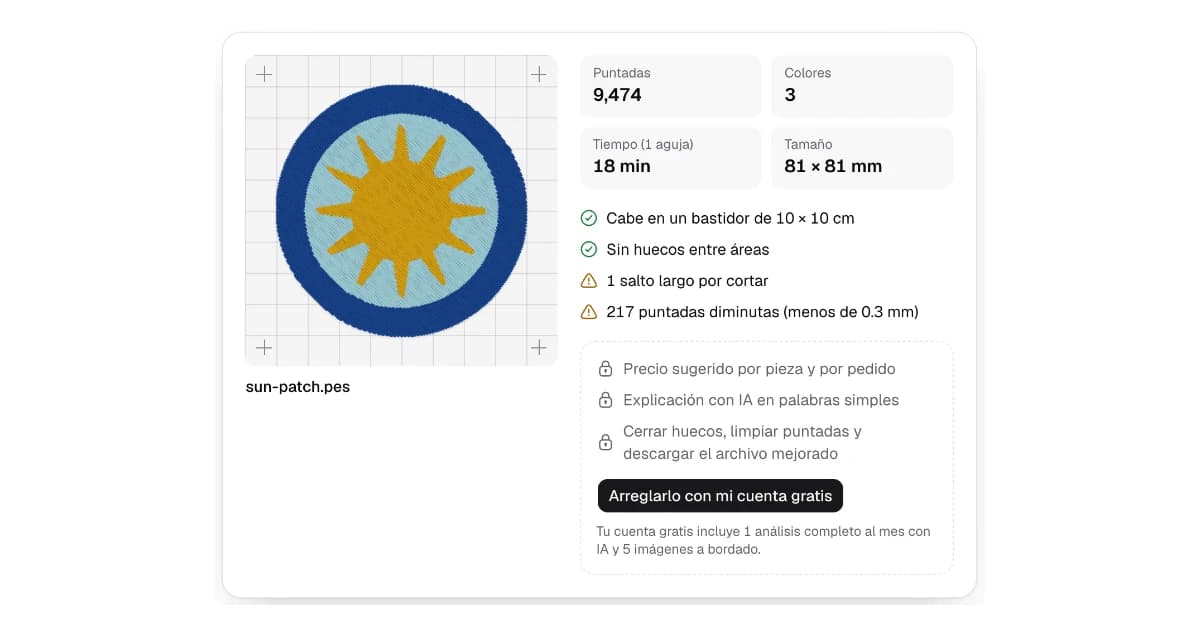
If the customer sent a PES, DST or JEF, drop it into the free file check on the home page: with no account, it tells you the stitch count, colors, size, minutes and any gaps or long jumps that will cost you time. With those numbers your quote is no longer a guess.
Frequently asked questions
Is embroidery priced by stitch count or per piece?
Both. Many shops publish a table by stitch range and quantity and turn it into a per-piece price. Stitches matter because they set the machine time.
How much is a digitizing fee?
It's a separate, one-time charge per design. As published examples, one Texas shop charges 30 to 50 USD per logo and a Washington shop 50 USD per hour with a one-hour minimum.
How do I know a design's stitch count?
If you have the PES, DST or JEF file, drop it into Satinwise's free file check: it shows stitches, colors, size and minutes with no account. Without a file, quote a range and confirm once you have it.
Does the Satinwise calculator cost anything?
No. The embroidery price calculator is free and needs no sign-up. The Free plan also includes the manual quoter.
Published October 19, 2026